

What Tower Rush 2 is
Tower Rush 2 is the second tower game from Galaxsys, the fast-games studio of the Digitain group, released on 22 October 2026. The format: a crane holds a building floor; you press BUILD; the floor drops; if it lands, its multiplier is applied to your stake and you choose between CASHOUT and another BUILD. There is no height limit and no timing skill — the drop is resolved by the game's provably fair engine the moment you press the button.
The 2024 original built a following in India and Pakistan on exactly that loop. The sequel keeps it untouched and spends all its changes on what happens when a round ends.
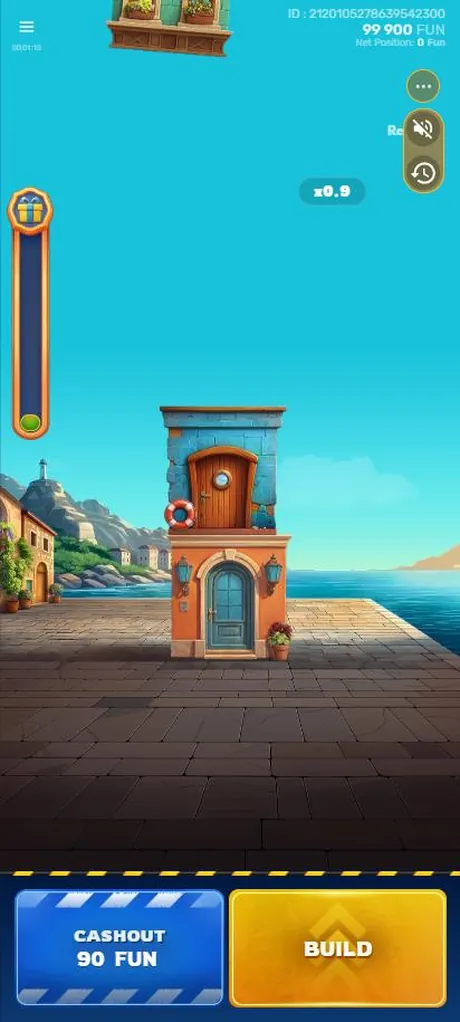
What is new, feature by feature
50% Cashout — 9/10
From a total of 3.00× a green tab appears next to CASHOUT. Press it and half the current win is credited; the other half stays in the round. Once per round; the tab hides again if the total drops below 3×. We used it in round 3 at 5.01×: 250.44 FUN landed in the balance, the remaining 250.44 rode on and collapsed on the next floor. Without it that round would have been a zero. It is the single best addition in the game.
Re-Buy — 7/10
Offered only when a collapse happens at 10.00× or higher, for 70% of the win you held. It is well designed — a timed offer, once per round — but in 135 rounds we never collapsed at 10× — our two towers above 10× (13.9× and 15.0×) were cashed out by Auto-Bet — so for a typical session it is theoretical. Players who use Triple Build floors or long runs will meet it; everyone else should treat it as a footnote.
10-floor Bonus Round — 8.4/10
A separate night tower with ten automatic drops that cannot bust: a x0 floor removes the most recent positive multiplier instead of ending the round. Entry comes from the Progress Bar (free), a Bonus floor in normal play, or Buy Bonus at 100× the stake. Our purchased round in this session returned 83.35× (8,334.95 on a 100 base bet, against a 10,000 price); an earlier one 88.51×. The free route is slow: the Progress Bar reached a third after 36 bets. Value depends almost entirely on how you enter.
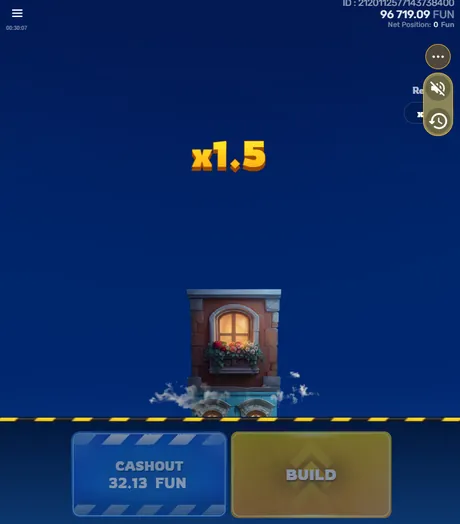
Progress Bar and Double Chance — 8/10
The bar is visible at all times on the left and persists between sessions, which makes it a reason to keep playing at the same stake. Double Chance adds 25% to every bet (the stake field reads 125 at a 100 base) and doubles the organic trigger odds. Over 25 auto rounds it cost us 625 FUN and produced no trigger — expected at that sample size, but worth knowing.
Observed, not advertised
Thirteen of the forty floors we logged landed between 0.40× and 0.90×. The rules say a landed floor "wins at the corresponding odds"; they do not promise those odds are above 1×. Expect towers that shrink before they grow.

Play Tower Rush 2 where we confirmed it live
The sequel is rolling out across Galaxsys partner casinos and availability differs by country. This button leads to the casino where we confirmed it live on 2026-11-10: the 10-floor Bonus Round, 50% Cashout and Re-Buy were all enabled. Details on the where-to-play page.
Score breakdown
| Criterion | Weight | Score | Why |
|---|---|---|---|
| Mechanics & exits | 30% | 9.2 | 50% Cashout and Re-Buy are precisely specified and work as written |
| Transparency | 20% | 9.0 | RTP, limits, thresholds and x0 rule all in the in-game text; provably fair round IDs |
| Bonus Round value | 20% | 8.4 | Cannot bust; free entry is slow at small stakes; buy price is steep |
| Mobile UX | 15% | 8.8 | Portrait-first, 15–25 MB first load, DOM history panel, clear buttons |
| Availability | 15% | 6.5 | Staggered rollout: availability differs by country and keeps changing; tested live by us at one casino as of Nov 2026 |
| Weighted total | 8.6 |
Against the 2024 original
| Aspect | Tower Rush (2024) | Tower Rush 2 (2026) |
|---|---|---|
| Exit options | Cash out all, or lose all | Full, 50% at 3×, Re-Buy at 10× |
| Bonus | Frozen / Temple floors | 10-floor round, three entry routes |
| Auto-Bet stop rules | Multiplier | Multiplier or floor count |
| RTP | 96.2–97.6% by operator | 97.00% stated |
| Operators (IN/PK) | Many | Rolling out; varies by country |
Who it suits
- Original Tower Rush players who lost rounds at 4× trying for 6×: the 50% tab is for you.
- Auto-Bet users: the 3.00× stop rule gave us the steadiest balance curve.
- Bonus hunters with a budget for 100× purchases.
- Not yet for anyone whose usual casino has not added the sequel — availability still differs by country.

Vikram Sethi
Vikram spent seven years as a QA engineer at two mobile game studios before switching to independent reviewing in 2021. He tests every fast game the same way: a fixed stake, a written protocol, and a round-by-round log pulled from the game's own history panel. He does not accept review fees from operators.
Sources
- Galaxsys, in-game "How to Play" screen of Tower Rush 2 (demo client), read 10 Nov 2026
- Galaxsys, Tower Rush 2 product page, galaxsys.co, accessed 9–10 Nov 2026
- Our demo history panels, two sessions, 135 rounds, 10 Nov 2026 (see Session Log)